

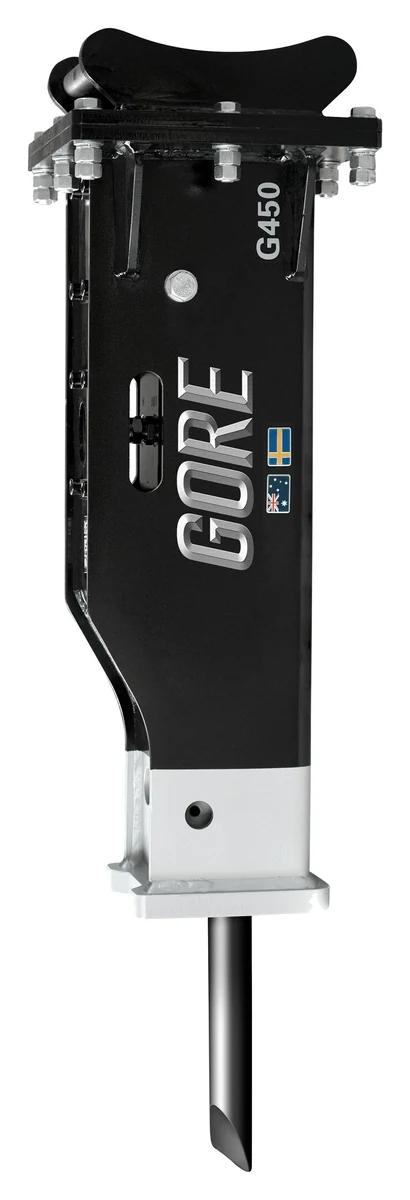

Hydraulic breaker G450 for 1.2–3 t excavators
- Excavator 1.2–3 t
- Working weight 91 kg
- Tool diameter 45 mm
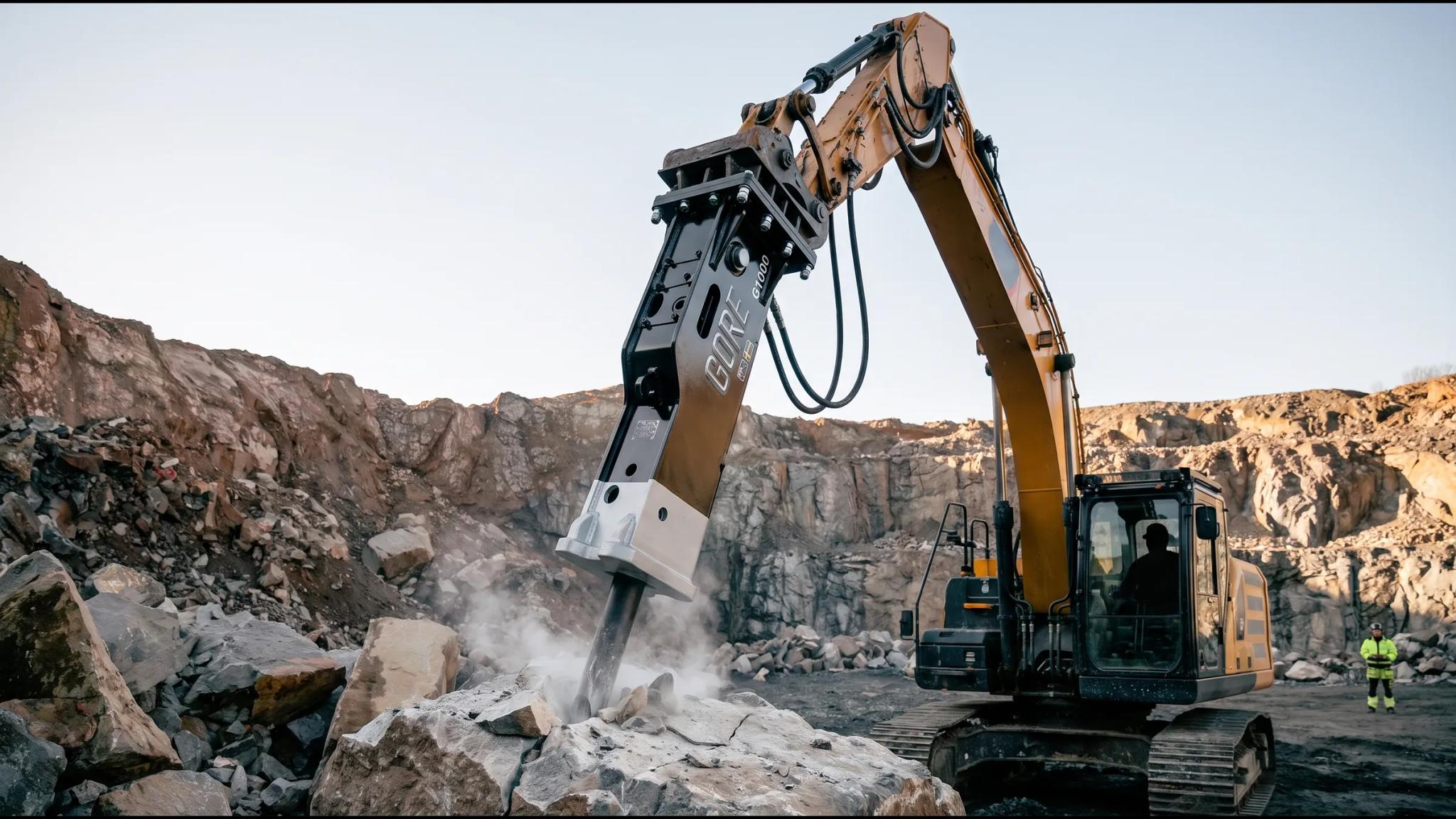

GORE series · G450 to G1000
A hydraulic breaker for excavators breaks rock, concrete, asphalt and frozen ground, driven by the machine's own hydraulic oil.
The GORE series has 6 models for excavators from 1.2 to 19 t, priced from €5,460 ex VAT. Pick the model by machine weight and oil flow, then the hitch that matches your quick hitch. Each one carries a warranty of 3 years.
Mini diggers
Midi excavators
Excavators
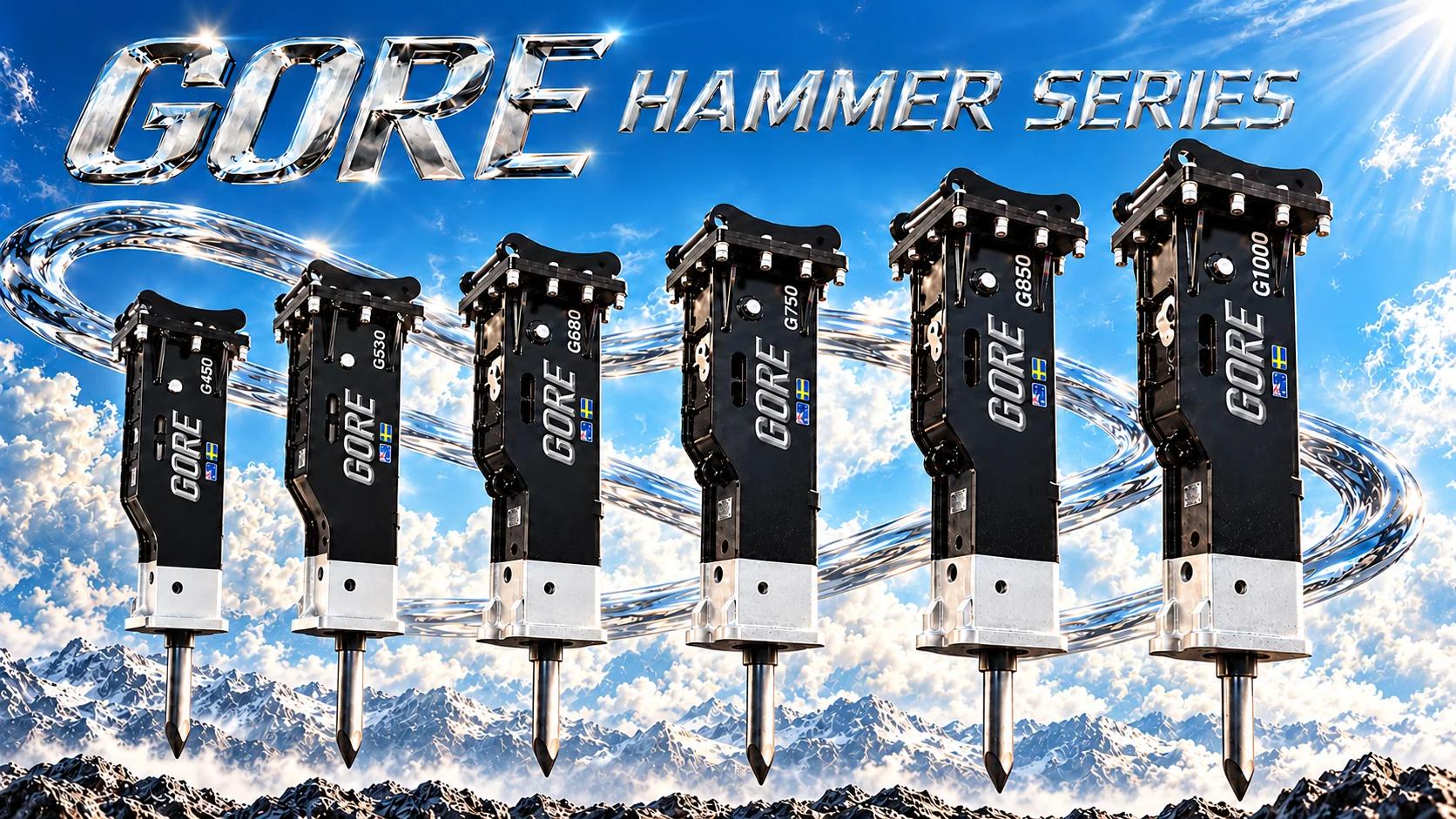
Send us your excavator's weight and the quick hitch it uses, and we match a GORE breaker and hitch to it.
Request a quote6
models, from the G450 to the G1000
1.2–19 t
excavator weights covered
1,200
blows a minute, the top rate in the series
100 mm
the largest tool in the series
−40 °C
cold-resistant outer shell
25 years
in mining and construction in Australia
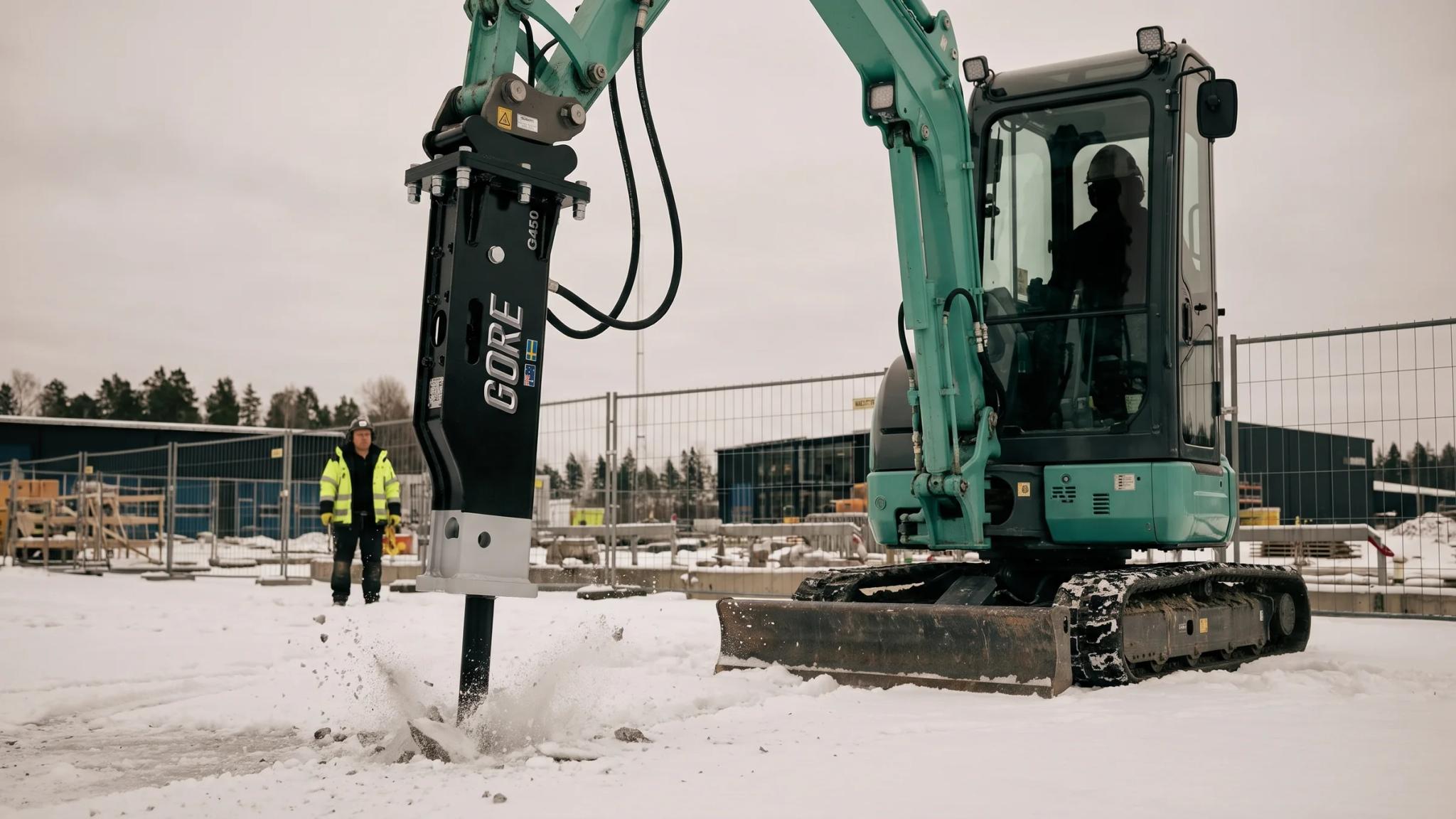
A hydraulic breaker for a mini digger has to suit the machine's small oil supply and short reach. These two suit house plots and gardens, foundation work and narrow service trenches.
The G450 fits machines of 1.2–3 t and takes 20–30 l/min. At 91 kg it is the lightest model in the series. It also has the fastest blow rate, 700–1,200 a minute, on a 45 mm tool.
The G530 covers 2.5–4.5 t on 25–50 l/min. It weighs 154 kg and drives a 53 mm tool. Both run on 1/2-inch hoses, and they are 215 and 230 mm wide.
700–1,200 blows a minute on the G450
Download the manual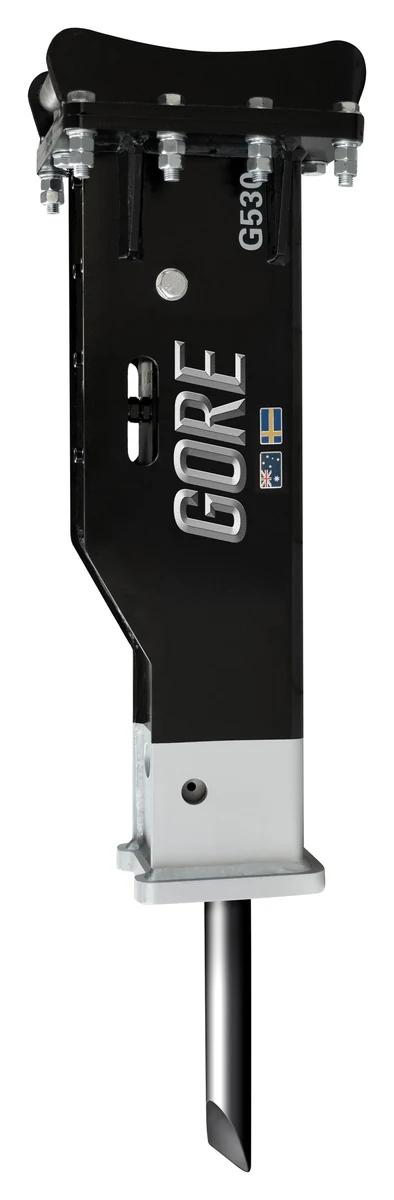
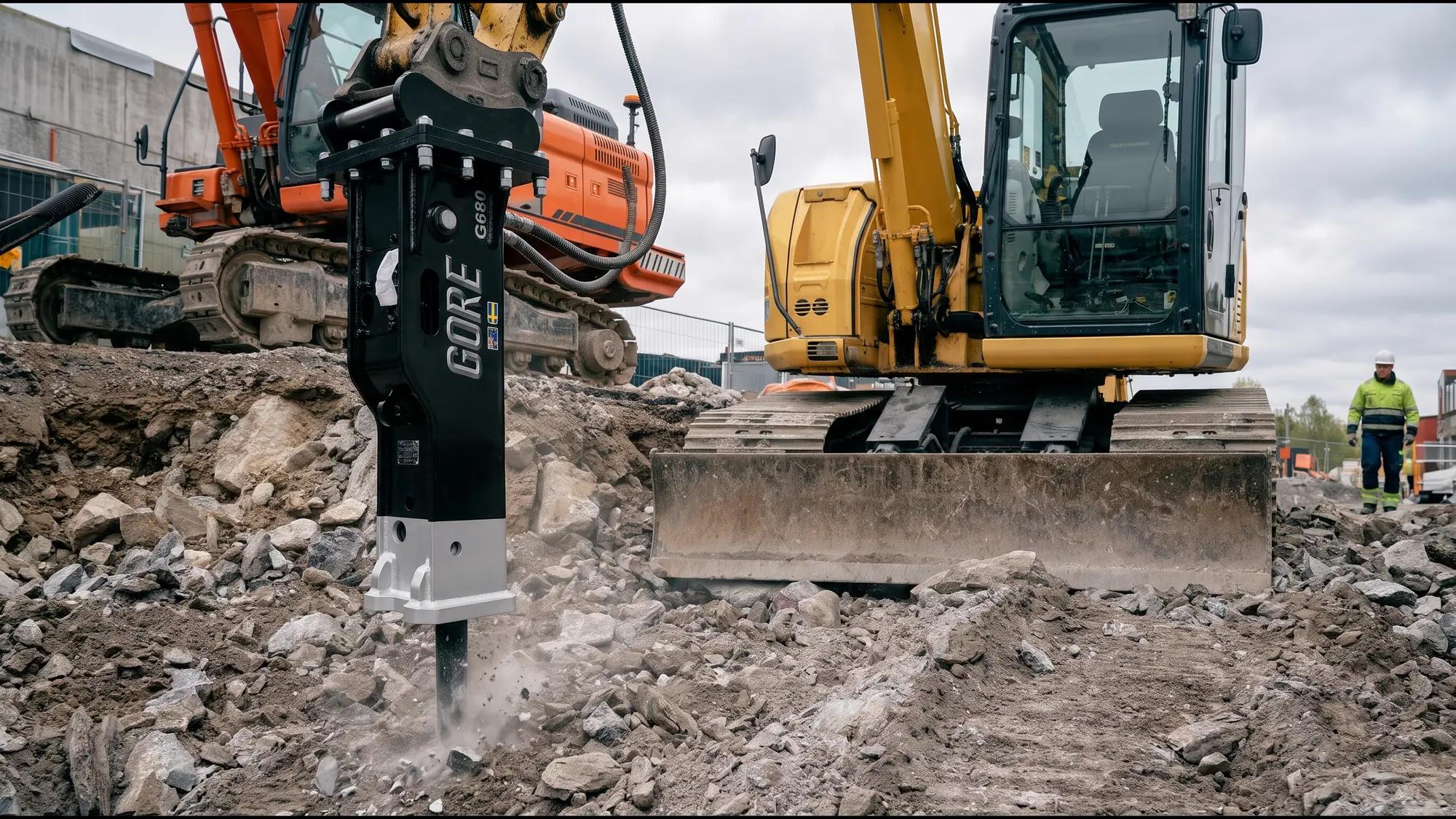
With a hydraulic breaker on the arm, a midi excavator takes on stony service trenches, footings, rock outcrops and old concrete slabs.
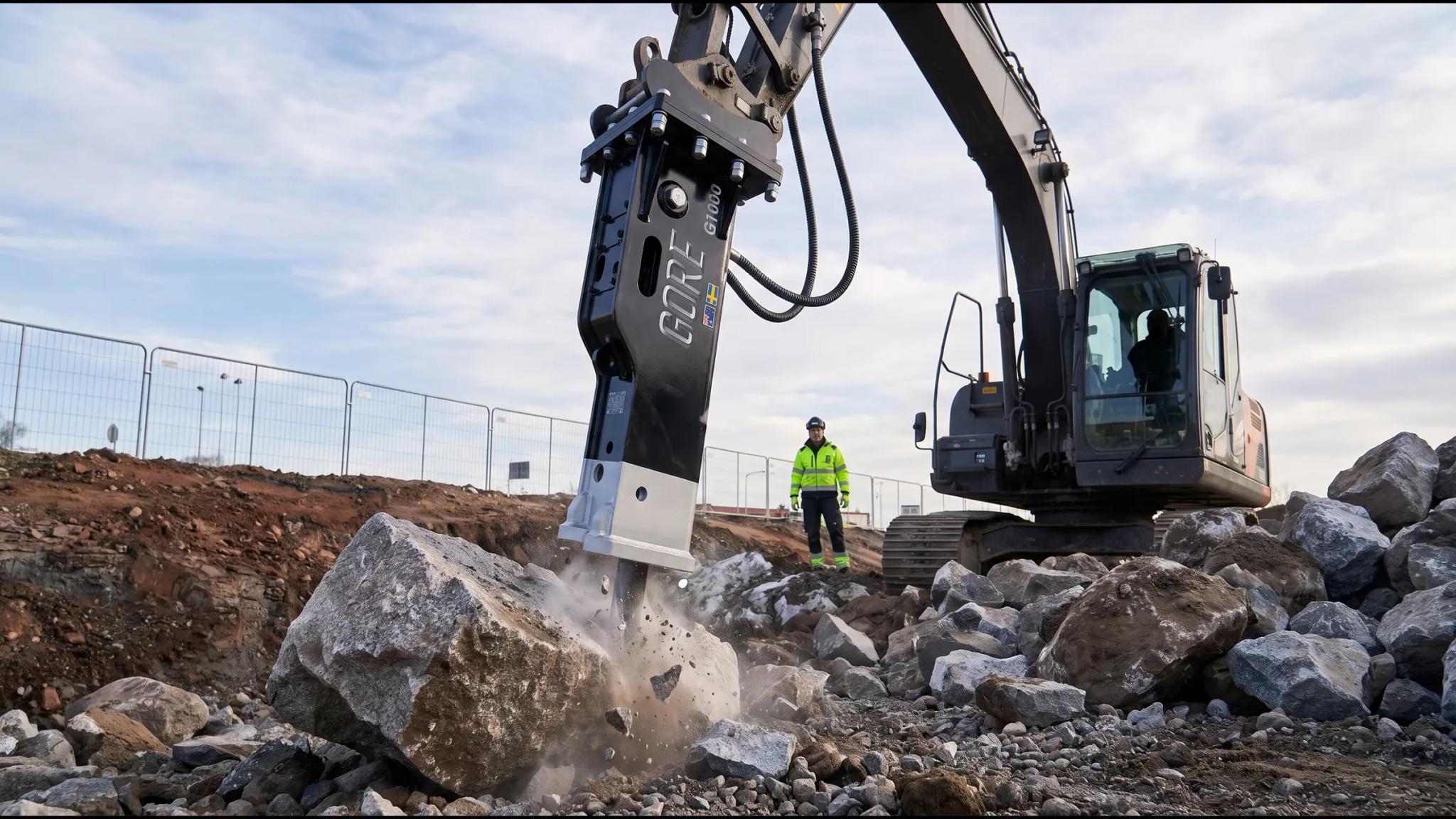
The G680 fits machines of 4–7 t on 40–70 l/min and 108–137 bar. It weighs 339 kg, takes a 68 mm tool and is the model on the cover of the GORE manual.
The G750 is for 6–9 t on 50–90 l/min and 118–147 bar. It weighs 405 kg and takes a 75 mm tool. The width is the same 295 mm as the G680, but the body is longer: 1,511 against 1,369 mm. Both models still run on 1/2-inch hoses.
68 and 75 mm tools on 1/2-inch hoses
Download the manual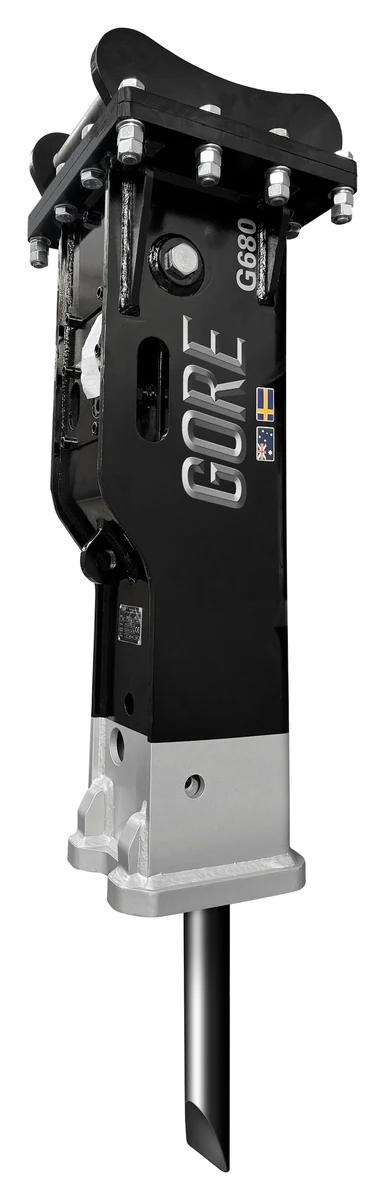
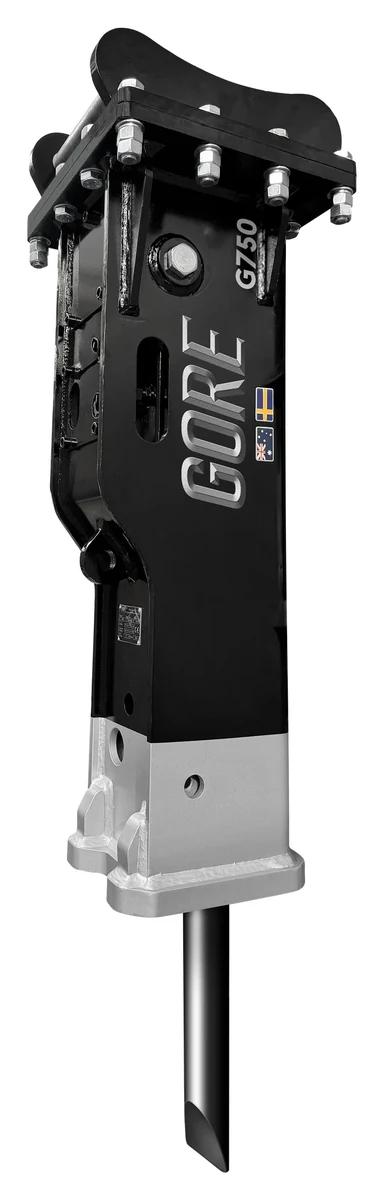
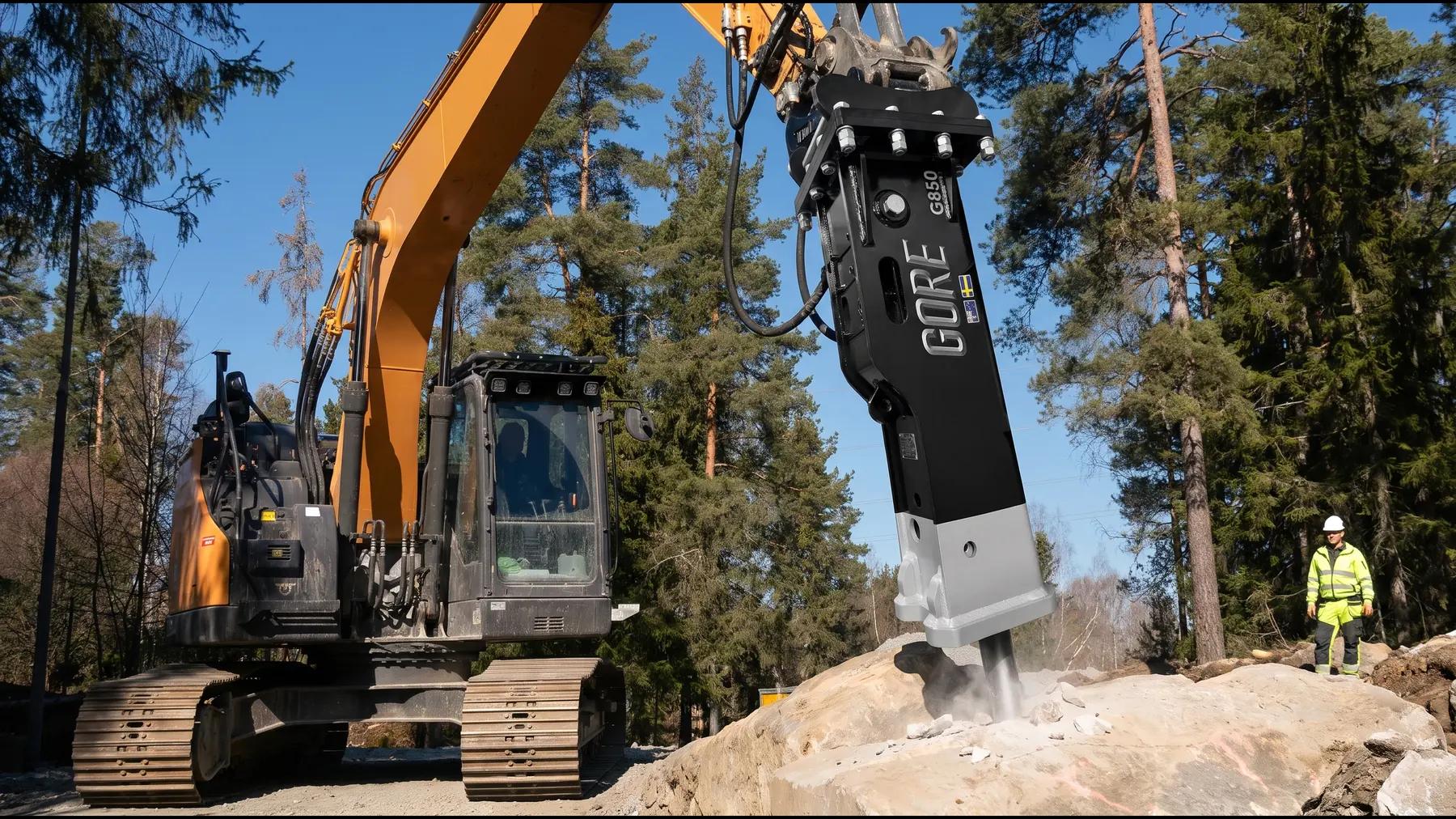
On a larger excavator the hydraulic breaker does the heavy work: rock cuts, boulders, reinforced concrete and foundations on bigger sites.
The G850 fits machines of 7–14 t, takes 60–100 l/min at 127–157 bar and weighs 633 kg. Its tool is 85 mm.
The G1000 covers 10–19 t on 80–110 l/min at 147–167 bar, with a working weight of 862 kg. Its 100 mm tool alone weighs 57 kg, so it goes in with the breaker hanging from eye-bolts or a sling.
Both models are 390 mm wide and step up to 3/4-inch hoses. A G1450 for heavier machines is on the way.
Tools up to 100 mm and 3/4-inch hoses
Download the manual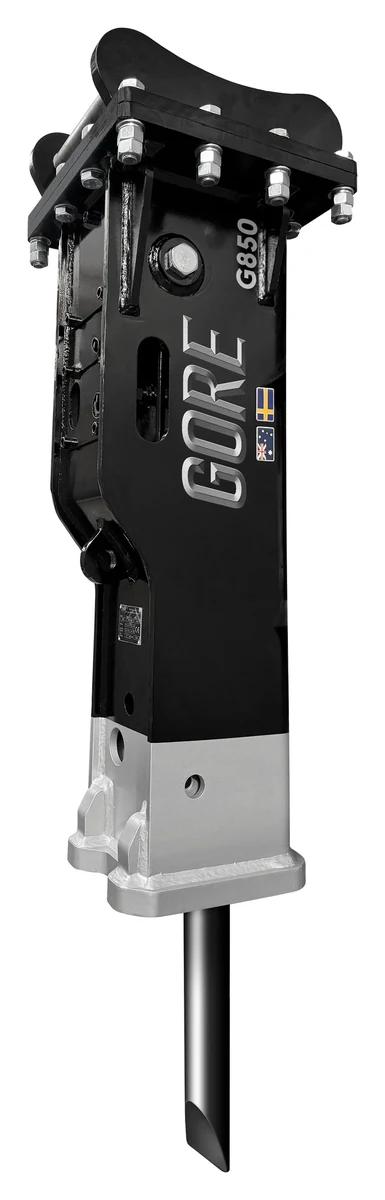
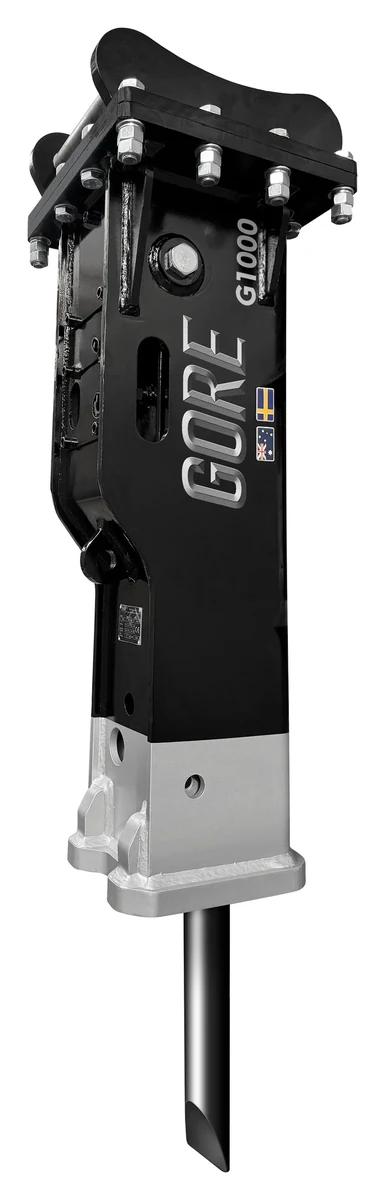
A hydraulic breaker goes on your excavator through an S-type hitch, the bracket with pins on top of the breaker. It has to be the same S size as the quick hitch on your machine. The hitch is not included in the breaker price. You choose it in the hitch picker on the model card and pay for that one only.
The S30 hitch sits on many mini diggers working on house plots, in gardens and along foundations. For S30 we match the GORE G450, made for excavators of 1.2–3 t. Typical work: old steps, paths and concrete that must go before building starts.
From €5,460 ex VAT · Choose S30 in the hitch picker
S30
S40 is the hitch on many heavier mini diggers and lighter midi excavators, often digging for water, power and fibre. For an S40 hammer we match the GORE G530 and G680, for excavators of 2.5–7 t. Typical work: rock in a service trench or a house foundation, and the outcrop that turns up halfway through.
From €6,169 ex VAT · Choose S40 in the hitch picker
S40
S40
S45 sits on mid-size midi excavators, often on drainage and groundworks. On S45 you get the GORE G750, for excavators of 6–9 t. Compared with the S40 breakers, you get a thicker tool and more weight behind the point. Typical work: rock that must come out before the foundation forms go in, and blocks split where they lie.
From €6,788 ex VAT · Choose S45 in the hitch picker
S45
S50 is fitted to heavier midi excavators and the lighter machines in the contractor class. For S50 we match the GORE G850 for excavators of 7–14 t, and here the hoses step up to 3/4 in. Typical work: rock cuts for foundations and services, and reinforced concrete broken into pieces a bucket can load.
From €8,953 ex VAT · Choose S50 in the hitch picker
S50
S60 is the hitch on larger crawler excavators doing the heavy breaking on big sites and in quarries. Here sits the GORE G1000, the largest fully specified breaker in the series, for excavators of 10–19 t. Typical work: hard rock, oversize blocks after blasting and thick reinforced concrete in demolition.
From €11,554 ex VAT · Choose S60 in the hitch picker
S60
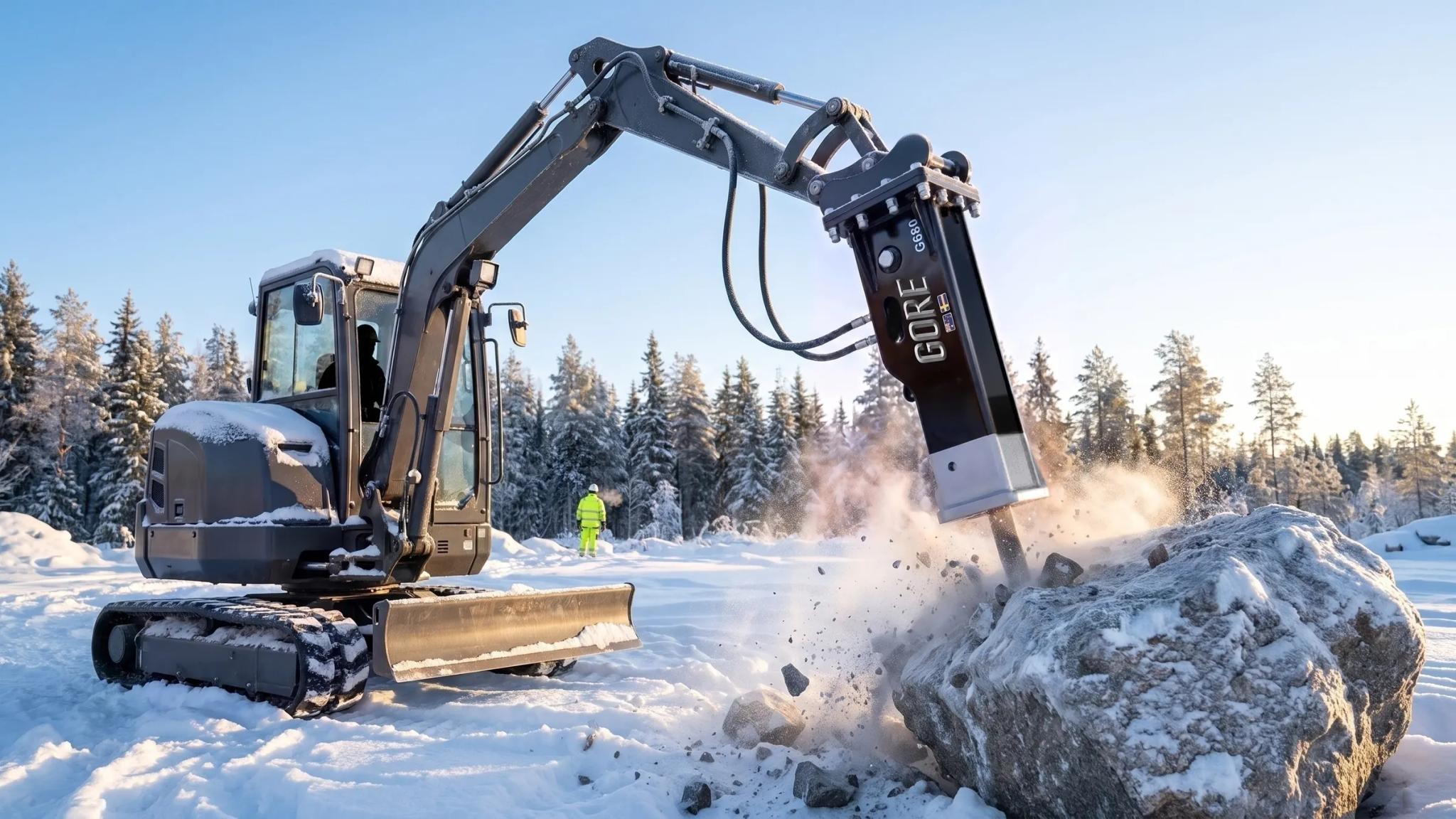
Frost in the ground and frozen blast rock are part of every Nordic winter. All our hydraulic breakers have a cold-resistant outer shell and work down to −40 °C.
The manual sets out the cold start. Warm the excavator first, let it idle for five minutes, then work the boom and arm for about five more.
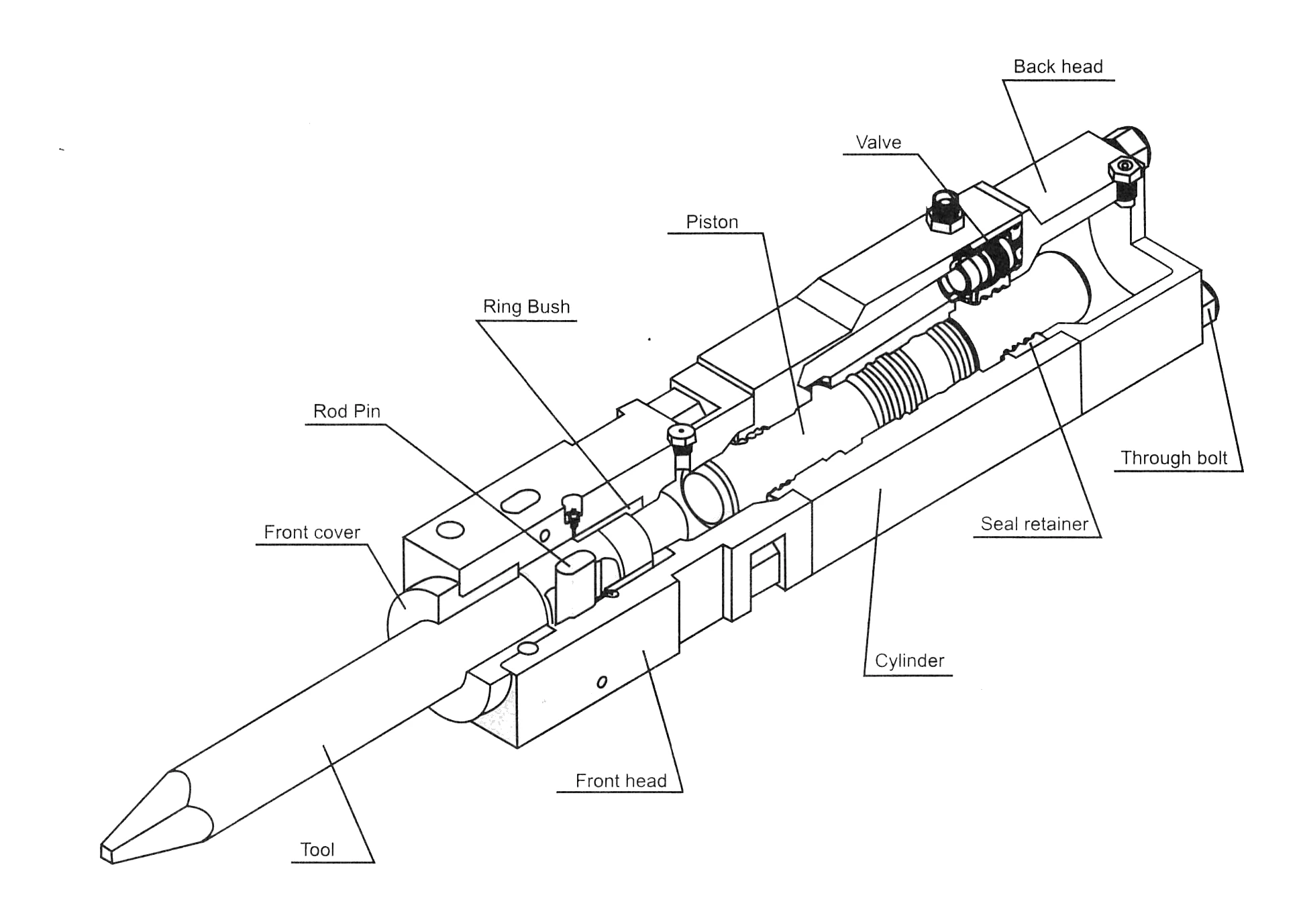
The piston in a hydraulic breaker makes the blow, driven by the excavator's oil, and passes it to the tool.
In a GORE breaker the cylinder carries the seals for both ends of the piston. That layout lets the seals be serviced without replacing the cylinder.
The control valve in a hydraulic breaker reverses the piston at each end of its stroke.
High pressure always acts under the piston, while the valve switches the chamber above it between high and low.
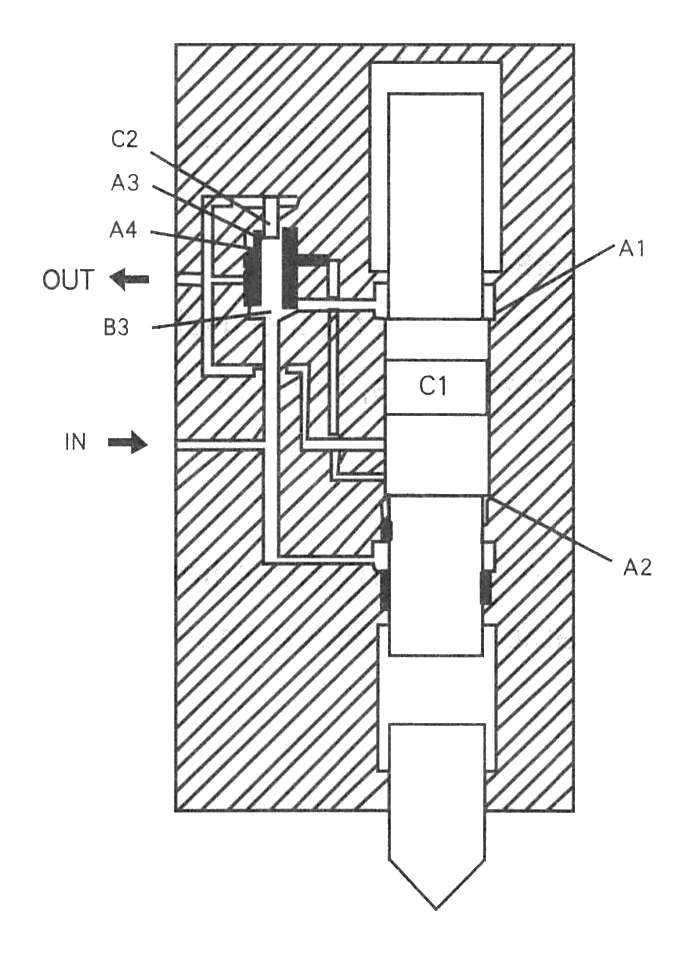
1 Start position
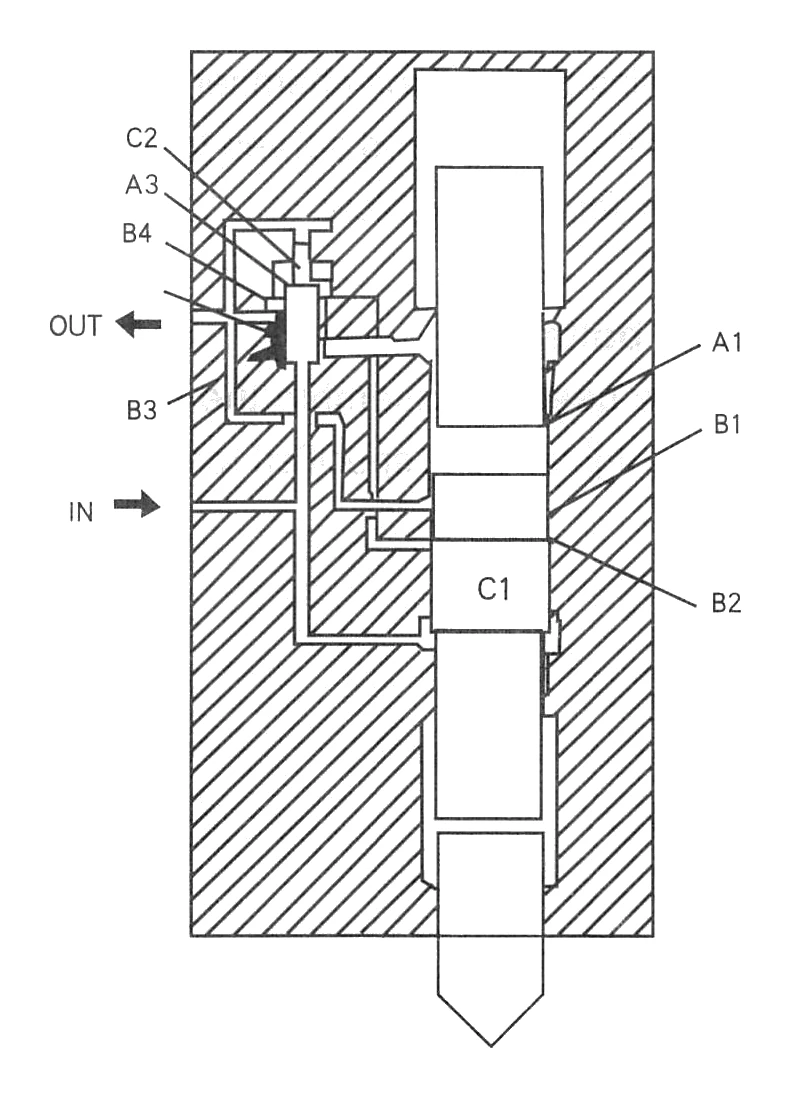
2 Piston reverses
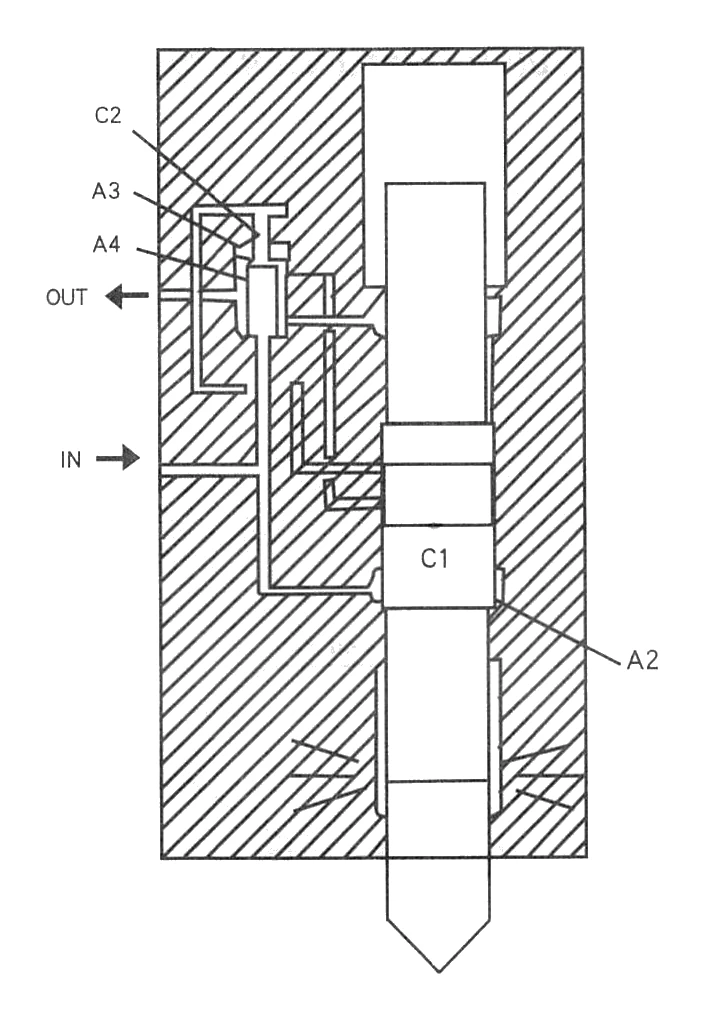
3 Valve switches
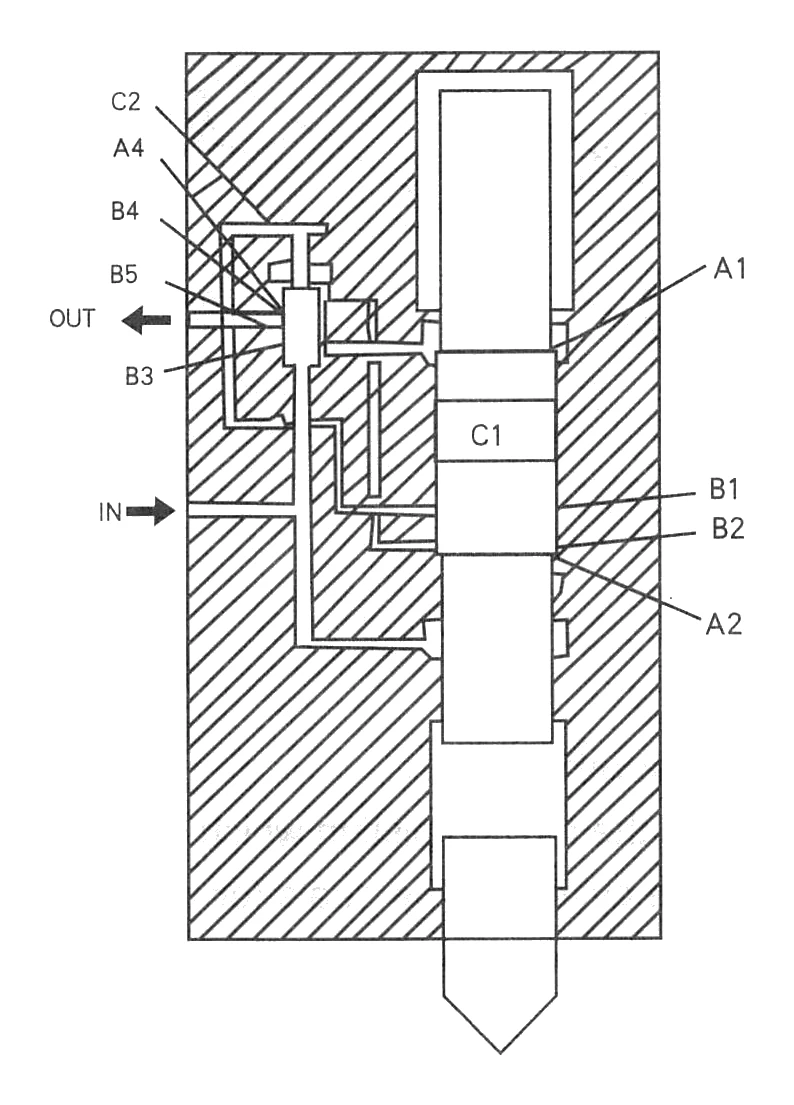
4 Impact, piston rises
The back head of a hydraulic breaker is a cushion chamber filled with nitrogen.
The manual describes the gas being compressed on the up stroke, absorbing the recoil and storing that energy for the next blow. On the down stroke it acts on the piston together with the oil.
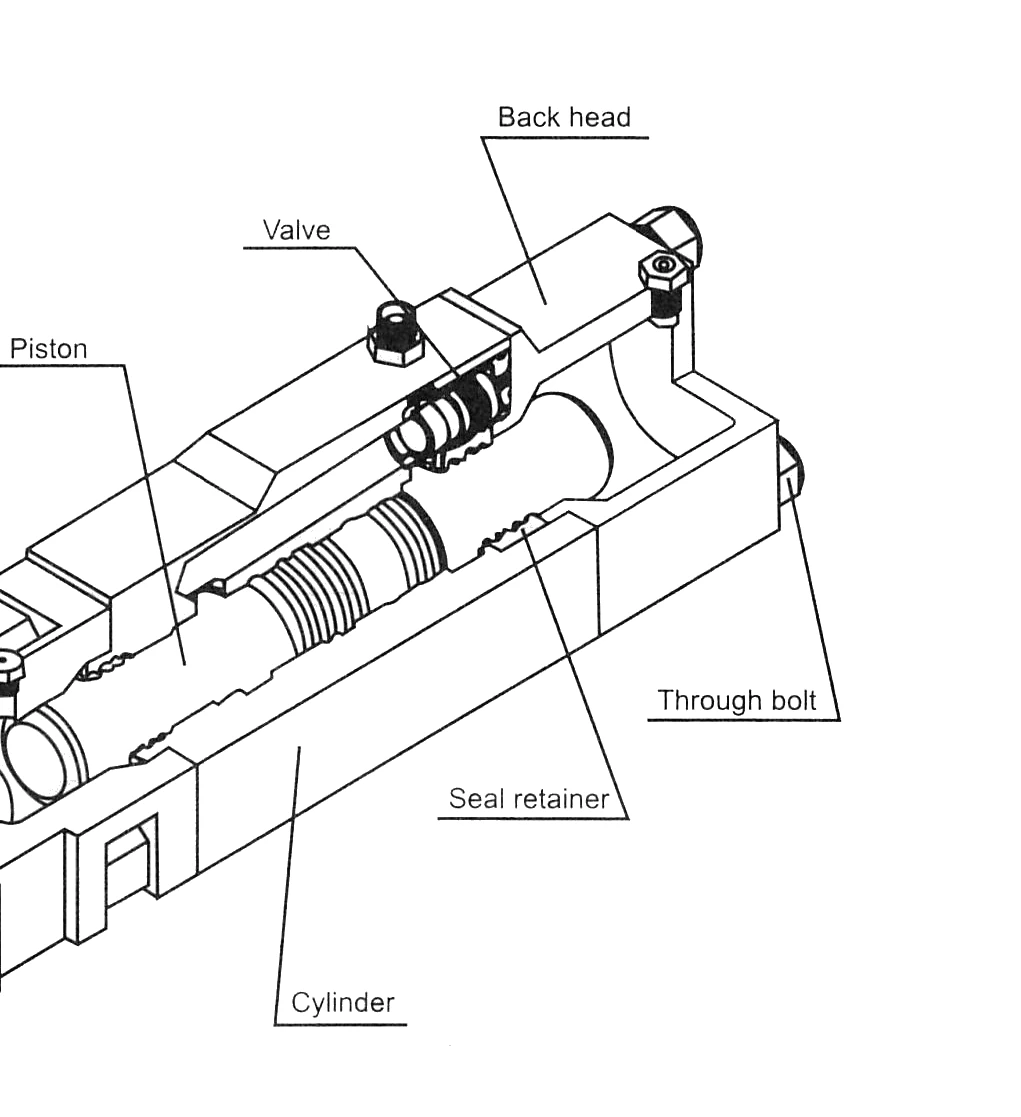
The seal retainer in a hydraulic breaker keeps the nitrogen in the back head and the oil inside the body.
It comes out as one part, so the seals it carries can be changed.
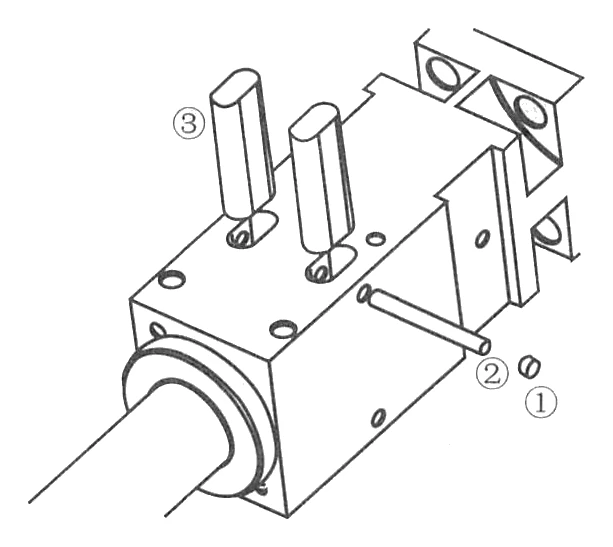
The front head of a hydraulic breaker holds the tool with two tool pins, a stop pin and a rubber plug.
The press pin for knocking them out comes in the tool box. Inside the front head, the ring bush guides the tool and has a stated wear limit for each model.
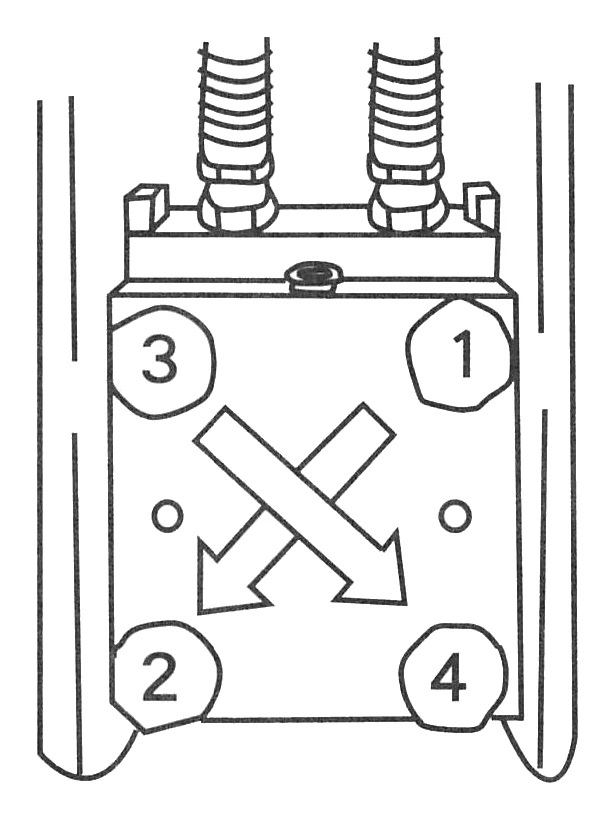
Through bolts hold a hydraulic breaker's front head, cylinder and back head together.
Each model has its own torque, from 500 Nm on the G450 to 2,000 Nm on the G1000. The bolts go on in a cross pattern, one turn at a time, with a torque wrench. Because the body comes apart, a workshop can open it for service and torque it back up.
What each part of a GORE hydraulic breaker does for you:
Typical work for a hydraulic breaker on an excavator:
The GORE hydraulic hammer series runs from the G450 to the G1000, and the model number tells you the tool size. A G450 takes a 45 mm tool, a G1000 a 100 mm one.
Every model shares one design, with a nitrogen chamber in the back head and a hydraulic control valve. Through bolts clamp the front head, cylinder and back head into a body that opens for service. The tool runs in a replaceable ring bush. Every model has a cold-resistant outer shell and works down to −40 °C.
In the box: tool kit, Dekker pressure gauge, nitrogen chamber, standard hoses, couplings, pointed chisel and flat chisel.
Get the full GORE manual as a PDF, with every specification, the installation layout and the service schedule. Enter your e-mail and we send it over.
| GORE series at a glance | |
|---|---|
| Excavator weight | 1.2–19 t |
| Hitch | S30 to S60 |
| Oil flow | 20–110 l/min |
| Cold-resistant outer shell | works down to −40 °C |
| Price from | €5,460 ex VAT |
| Warranty | 3 years |
| Dispatch | In stock: ships next business day |
| Spec | G450 | G530 | G680 | G750 | G850 | G1000 |
|---|---|---|---|---|---|---|
| Excavator weight (t) | 1.2–3 | 2.5–4.5 | 4–7 | 6–9 | 7–14 | 10–19 |
| Hitch | S30 | S40 | S40 | S45 | S50 | S60 |
| Working weight (kg) | 91 | 154 | 339 | 405 | 633 | 862 |
| Body weight (kg) | 67 | 85 | 152 | 210 | 278 | 475 |
| Oil flow (l/min) | 20–30 | 25–50 | 40–70 | 50–90 | 60–100 | 80–110 |
| Working pressure (bar) | 88–117 | 88–117 | 108–137 | 118–147 | 127–157 | 147–167 |
| Blow rate (blows/min) | 700–1,200 | 600–1,100 | 500–900 | 400–800 | 400–800 | 350–700 |
| Tool diameter (mm) | 45 | 53 | 68 | 75 | 85 | 100 |
| Tool length (mm) | 500 | 580 | 702 | 710 | 745 | 1,055 |
| Tool weight (kg) | 8 | 10 | 18 | 22 | 29 | 57 |
| Hose | 1/2″ · 1,450 mm · 140 bar | 1/2″ · 1,450 mm · 140 bar | 1/2″ · 1,450 mm · 140 bar | 1/2″ · 1,450 mm · 140 bar | 3/4″ · 1,850 mm · 170 bar | 3/4″ · 1,850 mm · 170 bar |
| Length (mm) | 1,086 | 1,174 | 1,369 | 1,511 | 1,731 | 1,896 |
| Price ex VAT | €5,460 | €6,169 | €6,399 | €6,788 | €8,953 | €11,554 |
Working weight is the weight with a top mount from the manufacturer's manual, without the hitch.
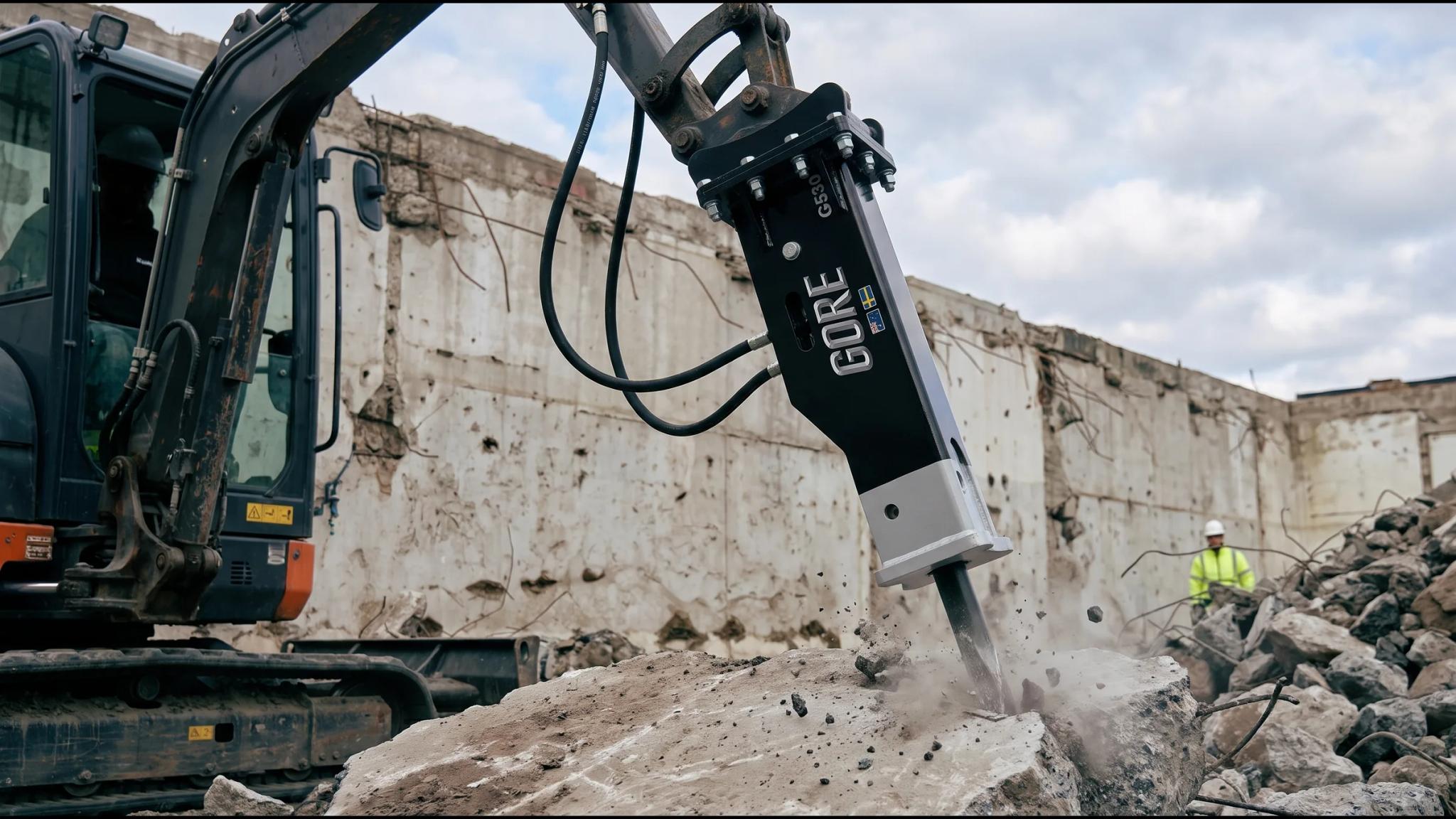
We sell two lines of hydraulic breaker. GORE is the series for contractors who break rock and concrete most weeks of the year. AWA is the lower-priced line for lighter and occasional jobs. Both are sold and supported by us, and the table sets the two side by side.
| GORE | AWA | |
|---|---|---|
| Built for | Frequent work in rock and concrete | Lighter and occasional breaking |
| Warranty | 3 years | 2 years |
| Price ex VAT | €5,460–€11,554 | €5,187–€10,007 |
Every GORE hydraulic breaker comes with a warranty of 3 years. You register it in the customer portal once the breaker has arrived. Every model in stock ships next business day.
You can buy two ways. Order online from the model card, or send a quote request with your machine and the job. We then confirm the breaker and hitch before you pay.
A hydraulic breaker and the excavator carrying it work as one unit. The breaker takes its oil, pressure and mounting from the machine. This guide follows the order buyers meet the questions in. It starts with what a breaker is and how to size one, then moves on to fitting it and keeping it running. Every figure in it comes from the GORE manual or our catalogue.
A hydraulic breaker is an excavator attachment that turns oil flow into a fast run of heavy blows. Inside the body a piston strikes a steel tool, which drives each blow into rock, concrete, asphalt or frozen ground.
Many manufacturers call the same attachment a hydraulic hammer. On UK sites you also hear rock breaker or simply the breaker.
The excavator supplies the oil and holds the breaker against the material with down pressure. You fit one where a bucket cannot get through: trench rock, concrete walls and slabs, oversize boulders, frozen ground.
A hydraulic breaker works on oil from the excavator, which drives a piston up and down inside the cylinder. High pressure acts under the piston all the time. The control valve switches the chamber above the piston between high and low pressure, and that switching makes the piston cycle.
As the piston rises, it compresses nitrogen in the back head. At the top of the stroke the valve switches, and oil and gas drive the piston down together. The piston strikes the tool, and the tool passes the blow into the material.
The valve does all the timing itself. The operator only positions the breaker and presses the switch in the cab. The four-step drawing of the cycle is in the control valve section above.
Matching a hydraulic breaker to an excavator comes down to five checks, taken in order. The machine's weight narrows the choice to one or two models. Oil flow, working pressure and the hitch then confirm the fit, and the job settles the rest.
Start with the excavator's operating weight. Each GORE model lists the machine weights it is built for, from 1.2–3 t on the G450 to 10–19 t on the G1000.
A breaker that is too heavy loads the boom, stick and hitch, and the machine loses stability at full reach. One that is too small hits too lightly for the job, so every metre of trench takes longer.
Every breaker is built for a set oil flow, given in litres per minute. Across the GORE series it runs from 20 to 110 l/min.
With too little flow, the breaker cannot reach its blow rate. Too much, and the extra oil turns into heat and wear in the breaker and in the excavator's hydraulics. Check the flow your machine's auxiliary circuit delivers, not the total from the pump. The figure is in the excavator's manual or on its spec sheet.
Working pressure has to sit inside the breaker's stated range too. On GORE models it runs from 88–117 bar on the G450 to 147–167 bar on the G1000.
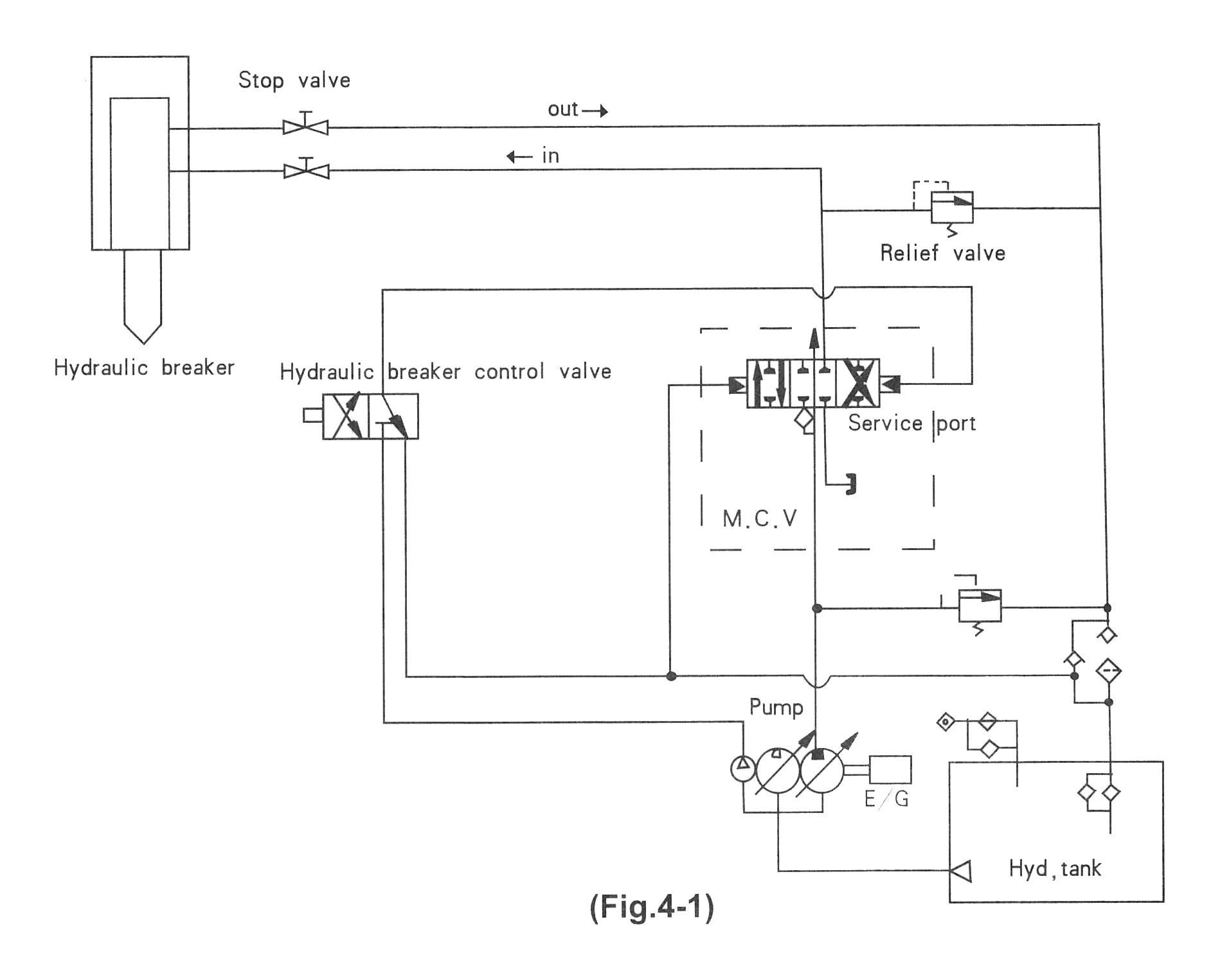
The relief valve on the breaker circuit is set 5 to 10 kg/cm² below the excavator's main relief setting. That keeps the pump protected while the breaker gets the pressure it is built for. Oil leaves the breaker through the return line and goes back to the tank through the filters.
The hitch on the breaker has to match the quick hitch on your excavator, size for size. GORE breakers take S-type hitches from S30 to S60, matched per model, from the G450 on S30 to the G1000 on S60.
The hitch is not included in the breaker price. You pick it in the hitch picker on the model card, so you pay for one hitch: the one your machine takes.
Two excavators of the same weight can need different breakers, because the work differs. For hard rock and thick reinforced concrete, take the heavier model your machine can carry. For trenching, light demolition and frozen ground, a model in the middle of your range is usually enough.
The job also picks the tool. Points go into rock; a chisel suits concrete, and a blunt tool takes oversize blocks. The tools section below covers each shape.
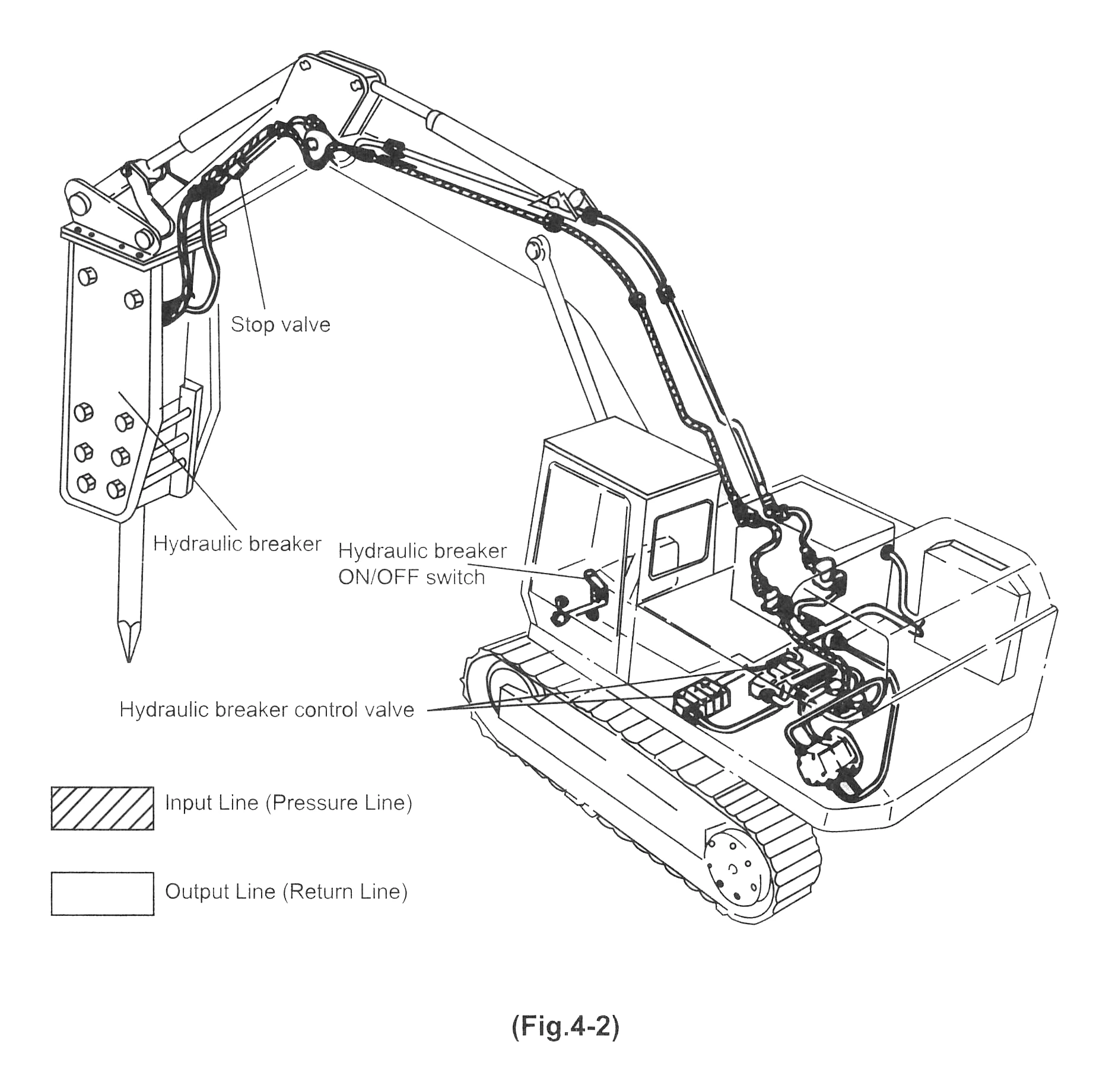
Does your excavator need hammer lines? Yes. A hydraulic breaker runs on its own circuit, fed from a service port on the main control valve.
The pressure line, marked IN, takes oil from the pump to the breaker. The return line, marked OUT, takes it back to the tank through the filters. In the cab, an ON/OFF switch works the breaker control valve, and two stop valves on the arm close the lines. A relief valve protects the circuit. If the excavator's main control valve has no pressure control valve, one is added.
Before the first job, set the flow inside the model's l/min range. The relief goes 5 to 10 kg/cm² below the excavator's main relief.
Hoses, from the manual: 1/2 inch × 1,450 mm at 140 bar up to the G750. The G850 and G1000 take 3/4 inch × 1,850 mm at 170 bar.
Mounting uses the bucket's pin points. Set the breaker on level ground, take out the bucket pins and line the arm up with the pin hole. Fit the pins, extend the bucket cylinder to the link hole and lock the pins with stop rings and a double nut. Then connect the hoses to the stop valves on the arm, warm the machine up and open the valves.
The right hydraulic breaker size starts with your excavator's weight, and oil flow and pressure confirm it. Find your machine's weight in the first column, then check that its auxiliary circuit delivers the flow and pressure on the same row.
| Excavator weight (t) | GORE model | Oil flow (l/min) | Working pressure (bar) | Tool diameter (mm) |
|---|---|---|---|---|
| 1.2–3 | G450 | 20–30 | 88–117 | 45 |
| 2.5–4.5 | G530 | 25–50 | 88–117 | 53 |
| 4–7 | G680 | 40–70 | 108–137 | 68 |
| 6–9 | G750 | 50–90 | 118–147 | 75 |
| 7–14 | G850 | 60–100 | 127–157 | 85 |
| 10–19 | G1000 | 80–110 | 147–167 | 100 |
The ranges overlap on purpose, because two machines of the same weight can have different hydraulics. An 8-tonne excavator, for example, sits inside both the G750 range and the G850 range. In an overlap, ask which breaker suits the job, not only which one suits the weight.
Rock is the main job for a hydraulic breaker, and the tool comes first. Fit a moil point, the standard tool for general breaking where you need no accurate cut, or the conical point.
Start at an edge or an existing crack, where the rock has room to move. Keep the tool square to the face and let the excavator hold steady down pressure. If a spot has not opened within 30 seconds, lift the point and set it a little further in.
Boulders too big for the bucket or the lorry split the same way, from a crack or an edge.
For concrete and demolition, a hydraulic breaker usually runs a chisel. The manual lists the chisel as the usual demolition tool. You can cut in line with the work or across it, depending on how you want the concrete to split.
On concrete pads and oversize blocks, the blunt tool cracks the piece instead of punching a hole through it.
Break slabs from the edge inwards, in pieces the bucket can load, and cut the reinforcement as it shows. Asphalt and the concrete under it come up the same way on road and yard jobs.
A hydraulic breaker takes five tool shapes, and the shape decides how the material breaks. Tool size follows the model, from 45 mm and 8 kg on the G450 to 100 mm and 57 kg on the G1000. The manual's tool section states that the tools are heat-treated for resistance to breakage and wear.
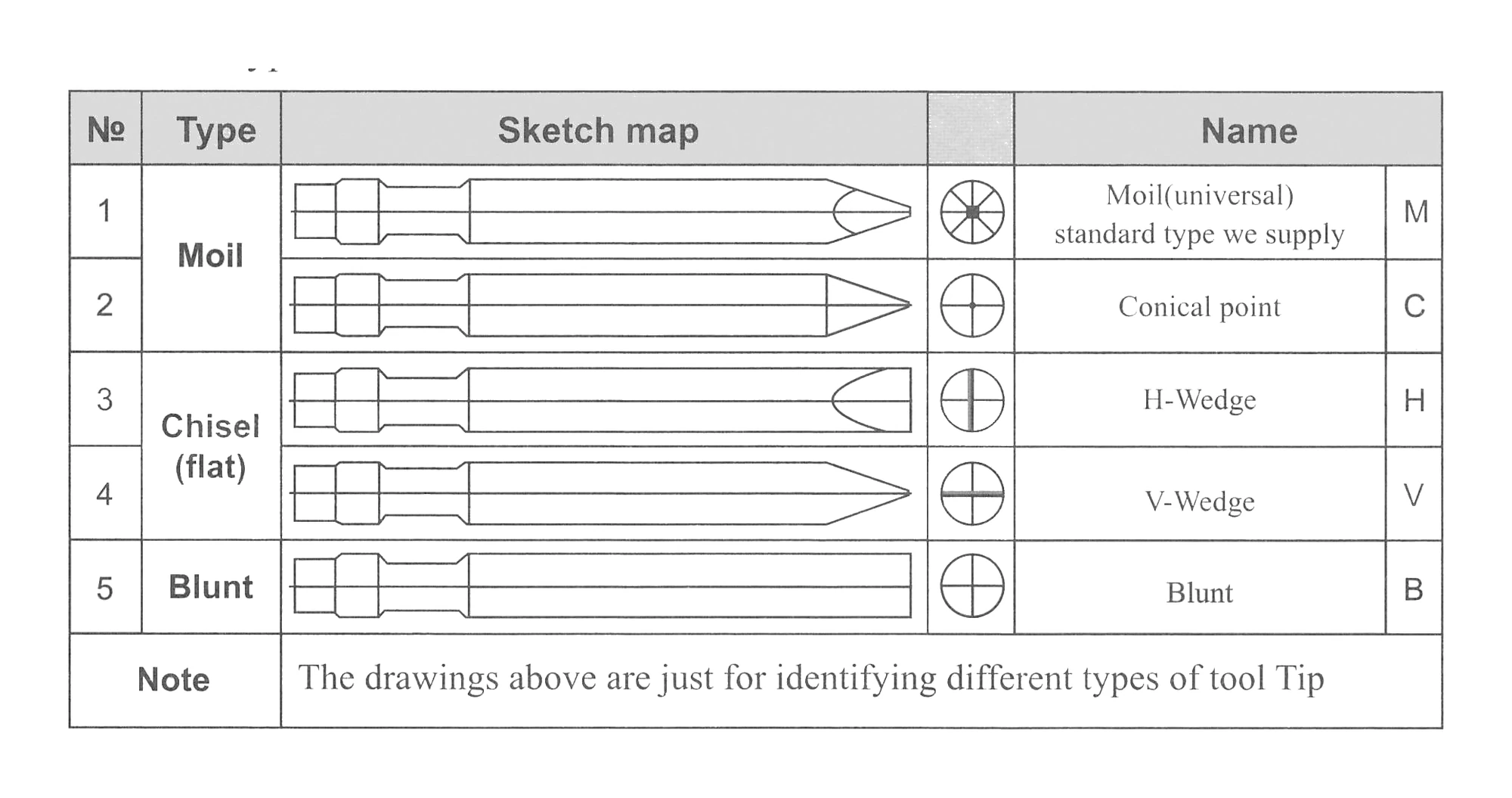
The moil point is the universal tool, coded M in the manual and the standard type supplied. It suits common breaking in rock and concrete where an accurate cut is not needed. If you keep one tool on site, keep this one.
The conical point, coded C, has a round, cone-shaped tip. It is the second pointed tool in the range, used for point breaking in the same way as the moil. On a new pointed tool, the manual counts up to 5 mm of length lost at the tip as normal wear.
The chisel has a flat blade and comes as an H-wedge or a V-wedge. It is the usual demolition tool, set in line with the work or across it. Its tip counts as normally worn once it is narrower than two thirds of the tool body's diameter.
The blunt tool, coded B, has a flat face. It is made for oversize material and concrete pads, where a chisel point would go through too quickly. The flat face spreads the blow, so the block cracks instead of being drilled.
A hydraulic breaker breaks best when the blows do the work and the boom only holds it in place. The manual's working rules come down to four habits.
Set the tool at right angles to the surface before the first blow, and keep it there as the material moves. Each blow then runs straight down the tool, and the tool and bush wear evenly. Hold enough down pressure to keep the tool seated, with at least 100 mm of stroke left on the excavator's cylinders.
Give each spot up to 30 seconds. If it has not cracked by then, lift the tool and set it a little further in from the edge. A fresh spot near an edge or crack gives the material room to split.
Let go of the switch the moment the material splits. Blows into empty space, known as blank firing, put the energy back into the breaker. The manual links them to wear on its major components.
Break with the breaker in line with the machine, in front of it or behind it. The boom and arm then take the load in the direction they are built for. Turn the excavator to face the work rather than reaching out to the side.
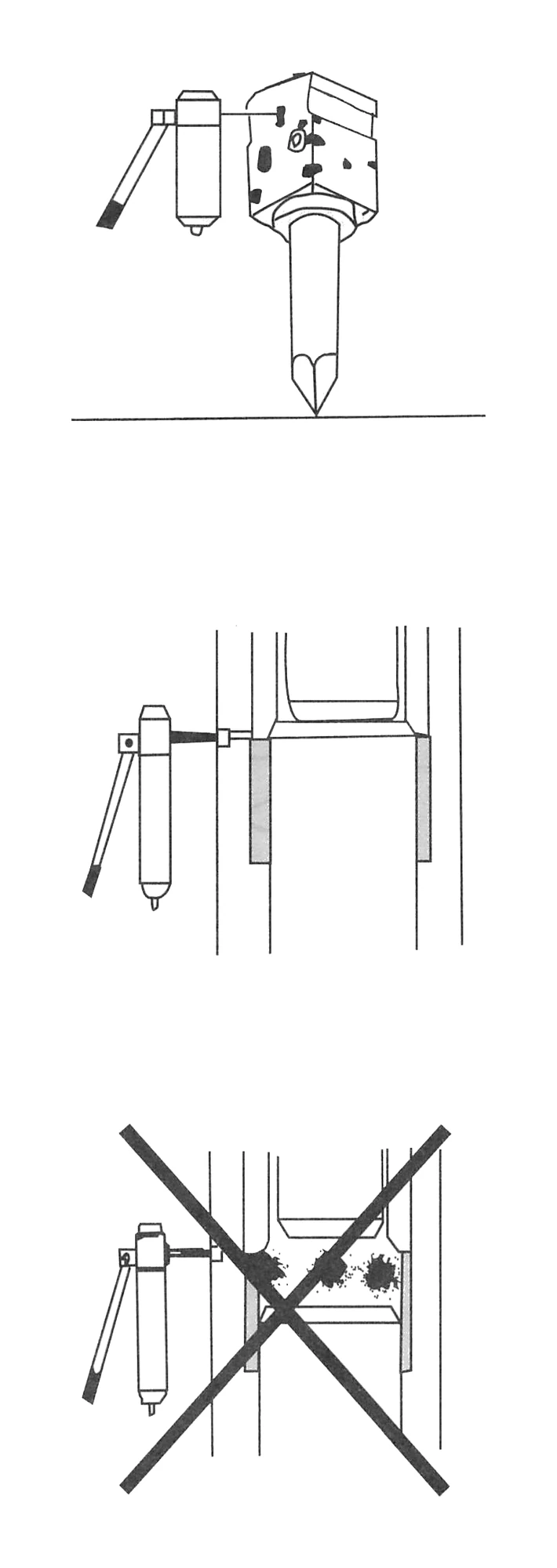
Greasing a hydraulic breaker is a job for every three hours of work, through one nipple on the front head. Stand the breaker upright and press it down on its tool, so the tool is pushed fully in. The grease then goes where it is needed, between the tool and the inner bush.
Use NLGI No. 2 grease. The manual names Esso Beacon Q2, Shell Retinax AM and Mobil Grease Special. Each time you fit a tool, give its shank a coat of the same grease. A greasing label on the breaker itself repeats the routine.
Hydraulic breaker service runs by the hour meter, and the GORE manual sets each interval. Most checks are quick ones done on site; the bigger work comes at 1,000 and 2,000 hours. Log the hours from day one, as the first retightening falls due after 10.
| Interval | What you do |
|---|---|
| Every 3 hours | Grease the front head; check oil temperature, pipes, hose connections and fasteners |
| First 10 hours | Retighten all bolts and nuts |
| Every 10 hours or daily | Remove burrs from the tool and tool pins, check the nitrogen charge, retighten the bracket bolts |
| Every 50 hours or weekly | Check the gap between tool and front cover, check the hoses, retighten the through bolts |
| Every 100–150 hours | Turn the face of each tool pin |
| Every 500 hours | Replace the tool pins |
| Every 1,000 hours or 6 months | Inspection by an authorised service workshop |
| Every 2,000 hours or yearly | Check connections, seals, piston, front cover and inner bush; fit new seals |
A hydraulic breaker body is built in three main parts, and knowing their names makes ordering spares simpler. At the top sits the back head with its nitrogen chamber. Below it, the cylinder holds the piston, which the control valve drives up and down. The seal retainer at the top of the cylinder keeps gas and oil apart. At the bottom, the front head carries the ring bush, the front cover and the pins that retain the tool. Through bolts run the length of the body and clamp the three parts together.
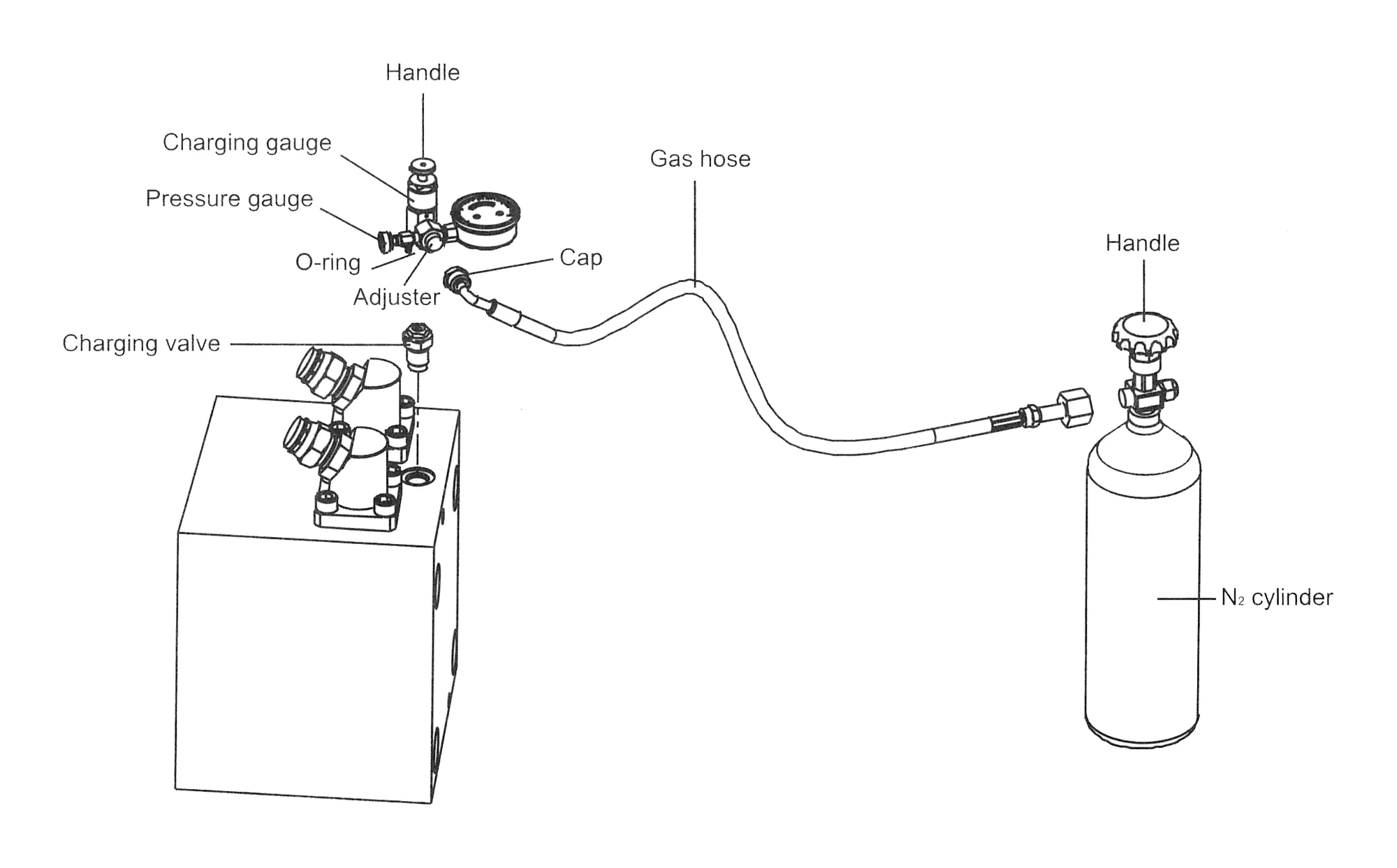
Check a hydraulic breaker's nitrogen charge, 16 to 17 kg/cm² on the G450 to G1000, every 10 hours or once a day. Do it with the breaker at normal temperature, and use nitrogen only. The manual's chart sets the charge against the outside temperature, from −20 to 40 °C.
The charging set connects a nitrogen bottle through a gas hose and gauge to the charging valve on the back head.
A hydraulic breaker runs on the excavator's oil, so the oil's condition sets how it performs. In use, the manual asks for a viscosity of 20 to 40 cSt and an oil temperature held between 40 and 60 °C. If the excavator has no oil thermometer, fit a reliable one.
Run ISO VG 68 in hot weather and ISO VG 46 in cold weather. The manual lists grades such as Shell Tellus 68 and 46 or Mobil DTE 16 and 15.
Start with the excavator's operating weight, then check its auxiliary oil flow. For mini diggers of 1.2–4.5 t, look at the G450 and G530. Midi excavators of 4–9 t take the G680 or G750, and machines of 7–19 t the G850 or G1000. Where two models overlap, oil flow and the job decide.
Between 20 and 110 litres a minute across the GORE range, depending on size. The G450 takes 20–30 l/min and the G1000 80–110 l/min. Your excavator's auxiliary circuit should deliver a flow inside the breaker's range, and the machine's manual gives that figure.
The GORE G450 for 1.2–3 t machines, or the G530 for 2.5–4.5 t. The G450 has the fastest blow rate in the series, 700–1,200 a minute. The G530 drives a 53 mm tool for heavier work. Both run on 1/2-inch hoses.
Yes. You change the tool, not the breaker. Points go into rock; for concrete and demolition you fit a chisel, and a blunt tool cracks large blocks and pads. In the box with every GORE breaker: tool kit, Dekker pressure gauge, nitrogen chamber, standard hoses, couplings, pointed chisel and flat chisel.
For general breaking in rock, stone and concrete, the moil point is the standard tool. The chisel, made as an H-wedge or a V-wedge, is the usual demolition tool. It cuts in line with the work or across it. A blunt tool suits oversize blocks and concrete pads, where a point would go straight through.
Every three hours of work. Stand the breaker upright with the tool pressed down, so the grease reaches the gap between tool and bush, and pump NLGI No. 2 grease into the nipple on the front head. Grease the tool shank too each time you fit a tool.
On the GORE G450 to G1000 it is 16 to 17 kg/cm² in the back head. Check it every 10 hours or once a day, with the breaker at normal temperature. Charge it with nitrogen only, using the charging set on the back-head valve.
Yes. A breaker needs a pressure line in and a return line to the tank. The circuit also has stop valves on the arm and a relief valve. The pressure line is fed from a service port on the main control valve. Set the relief 5 to 10 kg/cm² below the excavator's main relief.
No. You choose the hitch on the model card to match your excavator's quick hitch, so you pay only for the one you need. GORE breakers take S-type hitches from S30 to S60, depending on the model. If you are unsure of your quick hitch, send us a photo with a quote request.
A GORE hydraulic breaker costs from €5,460 ex VAT, depending on the model. Each model card on this page shows its live price and stock. The hitch is priced separately, so you add only the one that fits your excavator.
Yes, they are two names for the same attachment. UK buyers mostly say breaker or rock breaker, while many manufacturers write hammer. A GORE breaker runs on the excavator's oil. A nitrogen chamber in its back head stores recoil energy for the next blow.
That it matches your excavator's weight, oil flow and hitch. After that, look at servicing. A GORE breaker has a replaceable bush, new seals every 2,000 operating hours and greasing every three hours. Each model card shows the price and stock, and the warranty is 3 years.
Send us a quote request with your excavator's model and weight, and tell us what the breaker will be doing. We pick the hydraulic breaker that suits the machine and check the oil flow and hitch before we send a price. If you already know the model you want, order it online from its card. You can also call us on +46 10 520 04 68.
Keep exploring the range. Compare specifications and prices, and check each product for availability and lead time.